Subway Allergen Menu UK 2026: Check Allergens Before You Order
If you or your child has a food allergy, ordering at a sandwich counter can feel like a small exam you didn’t revise for. The good news: Subway UK does publish proper allergen information — you just need to know where it lives, and how to use it before you’re at the front of a lunchtime queue.
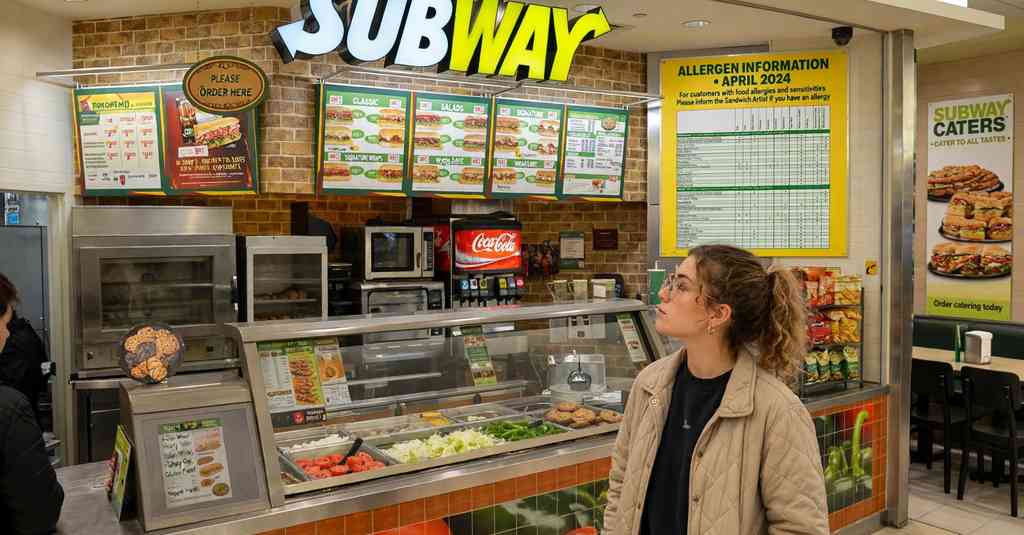
Here’s the short version. Subway keeps full allergen details for every product and ingredient on its official UK website, including a detailed allergen chart you can read at home. Stores hold the allergen information in store too, so staff should be able to show it to you or talk you through it. This guide covers where the information is, how to read it, and what to say at the counter — plus the one honest limitation nobody should gloss over: a made-to-order counter can reduce risk, but it can’t remove it completely.
WHERE TO FIND SUBWAY UK’S OFFICIAL ALLERGEN INFORMATION
There are three places to check, and ideally you’ll use the first before you leave the house.
Online. The Subway UK nutrition and allergen information page carries the allergen details for the current UK menu, and it’s where the full allergen chart lives — a table listing every bread, filling, cheese, sauce and side against all 14 allergens. In the chart, each ingredient is marked one of three ways: the allergen is in the product, it’s not part of the product as delivered to the store, or it “may contain” the allergen because it’s present where the ingredient is made. A plain-English key explains the symbols. If you’re looking at the numbers side of the menu too, our Subway calories guide pulls the same official data into a simpler chart.
In store. Everything at Subway is made to order rather than pre-packed, so the allergen details don’t sit on a wrapper. Instead, stores keep the allergen information in store, and you’re entitled to ask for it before you order. If the person serving you seems unsure, asking them to check with a manager is standard practice.
One habit worth building: check the chart at home, decide your order, then confirm in store — recipes and suppliers change, and a chart saved six months ago may no longer be current.
THE 14 ALLERGENS UK LAW SAYS MUST BE DECLARED
Under UK food law, businesses must tell you if any of 14 specific allergens are used as ingredients in the food they serve. Subway’s chart is built around the same 14 that appear in the Food Standards Agency’s allergen advice for consumers:
| # | Allergen | Where it typically turns up |
|---|---|---|
| 1 | Celery | Stocks, seasoning blends, salads |
| 2 | Cereals containing gluten | Bread, wraps, cookies (wheat, rye, barley, oats) |
| 3 | Crustaceans | Prawns, crab, lobster — rare at Subway |
| 4 | Eggs | Mayonnaise, egg patties, sauces |
| 5 | Fish | Tuna is the obvious one at Subway |
| 6 | Lupin | Some bakery flours — uncommon but declared |
| 7 | Milk | Cheese, butter, yoghurt-based marinades |
| 8 | Molluscs | Mussels, oysters, squid — not a Subway staple |
| 9 | Mustard | Dressings, sauces, seasoning mixes |
| 10 | Peanuts | Some cookies and desserts |
| 11 | Sesame | Seeded breads, some toppings |
| 12 | Soybeans | Sauces, marinades, processed meats |
| 13 | Sulphur dioxide and sulphites | Pickled veg, preserved meats (above set levels) |
| 14 | Tree nuts | Almonds, hazelnuts, walnuts — mainly bakes and cookies |
Two things to notice: peanuts and tree nuts are listed separately because they’re different allergens — being fine with one says nothing about the other. And the legal list covers ingredients, not traces from shared equipment, which is why the cross-contact section further down matters.
WHICH PARTS OF THE MENU COMMONLY CARRY WHICH ALLERGENS
This section is a map, not a verdict — it shows where the usual suspects hide, but the decision for your exact order always comes from the official chart and a word with staff, never from a general guide like this one.
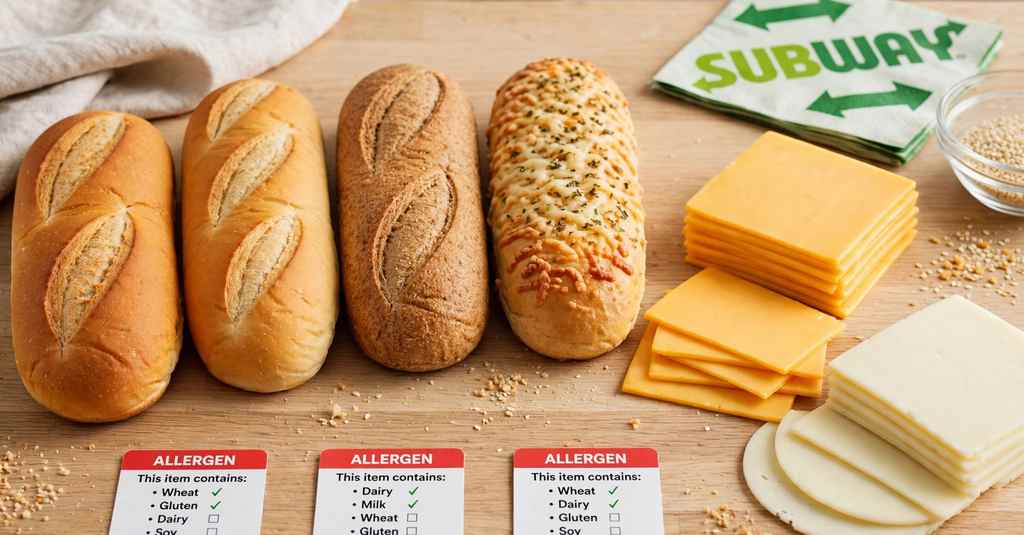
Bread is the big one for gluten. Every standard Subway bread is made with wheat, and the plain tortilla wrap is wheat-based too. Subway does offer a gluten-free bread — our Subway gluten-free menu guide explains how it works — but it’s prepared in the same area as everything else.
Cheese means milk, in every form on the counter, and cheese-topped breads carry it before you’ve added a filling. Milk also hides in marinades: chicken tikka is made with a yoghurt-based marinade, so milk can sit in a filling that looks dairy-free.
Sauces are where it gets fiddly. Mayonnaise-based sauces bring egg with them — including the tuna filling, which pairs fish with a mayo dressing, making it a two-allergen item. Teriyaki-style glazes commonly involve soya, and mustard hides inside dressings and seasoning blends. None of this makes a sauce off limits; it makes the sauce the line of the chart to read most carefully.
Cookies deserve extra caution if nuts or peanuts are your concern: some contain them, and because the range sits together in the display, Subway’s own allergen information flags that cookies may come into contact with nut-containing ones while on show. Fresh salad veg, by contrast, is the simplest part of the counter — though pickled items like jalapeños can involve sulphites, so confirm on the chart rather than assume.
HOW TO ORDER MORE SAFELY AT A MADE-TO-ORDER COUNTER
Everything at Subway is assembled in front of you, out in the open — and that’s an advantage if you use it. Here’s the order of play that helps most:
And if the answers feel vague — “should be fine, I think” — walk away. Confidence matters more than politeness here.
THE HONEST BIT: CROSS-CONTACT CAN’T BE RULED OUT
This is the part every allergy guide should say plainly. Subs at Subway are built on one shared counter: the same surfaces, boards and toaster handle bread, cheese, tuna and everything else all day long. Toppings come from open tubs, and crumbs travel.
Subway says this itself in its official allergen information: because most food is freshly prepared in store where allergens are handled, and equipment and utensils are used for multiple items, it cannot guarantee any product will be 100% allergen free. That’s not legal back-covering — it’s an accurate description of a busy sandwich line.
The steps above genuinely reduce the risk, and for many people they’re why eating at Subway works fine. But if your allergy is severe, only you, guided by your doctor’s advice, can decide whether a shared counter is a risk you’re comfortable with.
It also means “vegan” and “allergy-safe” are not the same thing. Subway’s own allergen information is clear that its plant-based items are made to vegan recipes but, being prepared alongside everything else, aren’t suitable for people with milk or egg allergies. If you’re choosing plant-based food because of an allergy rather than ethics, read our guide to Subway vegan options with that warning front of mind — and work from the chart, not the vegan label.
ORDERING FOR CHILDREN: A FEW EXTRA PRECAUTIONS
If you’re ordering for a child with an allergy, the stakes feel higher — because they are. Children can’t always describe early symptoms, or tell an adult straight away.
- Do the homework at home. Check the chart before the trip and agree on one or two orders you know inside out — the shop, with a hungry six-year-old beside you, is the worst place to read it first time.
- Speak for them, clearly. Tell staff it’s an allergy order for a child, and run through the same glove and utensil requests. Kids’ Pack subs are smaller versions of the same counter food — a 4-inch ham, chicken, tuna or Veggie Delite sub — so the same cross-contact points apply.
- Watch the cookie display. Cookies sit at child eye level, and small hands grab. If nuts are the issue, the display is itself a contact point; a packaged snack with a full ingredients label is often easier.
- Carry what you always carry. Your child’s prescribed medication, including auto-injectors if they have them, comes on every food outing — no exceptions because “we’re only popping to Subway”.
- Teach them the sentence. A child who can say “I have a nut allergy — please can you change your gloves?” is safer than one who’s learned to stay quiet and hope.
IF SOMETHING DOESN’T FEEL RIGHT
Trust your instincts. If your order comes back looking wrong, if you spot an ingredient you didn’t ask for, or if the person serving you can’t answer a basic question about what’s in something, don’t eat it. Ask for the manager, ask to see the allergen information, or simply leave it — no sandwich is worth a hospital trip.
If you do have a reaction, or find allergen information that’s wrong, reporting it — to the store, and to your local authority’s food safety team if it’s serious — helps the next person too.
FAQS ABOUT THE SUBWAY ALLERGEN MENU UK
FINAL THOUGHTS
Eating out with an allergy will probably never feel effortless, but Subway is one of the easier places to manage it — everything is made in front of you, the allergen information is published in full, and staff are used to being asked. Do the checking at home, speak up early at the counter, and keep the order simple.
One last thing, and it matters: recipes, suppliers and menus change without much fanfare, so treat this guide as a starting point rather than the final word. Check the official chart every time it matters, confirm in store before you order, and never rely on what was true last year.